


One of the easiest ways to create a non-toxic home is to be mindful of what you bring into your space. Maybe you’re like us and recently started reading product labels (spoiler: you can’t stop once you start). Now you may find yourself wondering if your entire home is full of toxic products.
Think: the nonstick pan you’ve had for years, the candle on your counter, the cleaners in your cabinet, even your couch. Suddenly, your entire space is the question.
Here’s the good news: creating a non-toxic home doesn’t mean you need to toss out everything you own. You don’t have to move into some sterile, chemical-free home, either. We’ll show you how to do it with simple product swaps as your current items run out.
Creating a non-toxic home is an extension of practicing self-care and wellness. You’re already taking steps to care for your health and well-being. So let’s expand those efforts to the air you breathe and the products you touch all day long.
Now, let’s walk through our favorite non-toxic swaps, room by room. We’ll cover your cleaning products and indoor air quality, then your kitchen, bedroom, laundry, bathroom, and furniture.
Why Your Indoor Air May Not Be as Clean as You Think
You may be surprised to learn that the air inside your home isn’t necessarily cleaner than the air outside. It’s often the opposite.
The EPA’s Total Exposure Assessment Methodology (TEAM) studies measured about a dozen common organic pollutants inside homes. Indoor levels were 2 to 5 times higher than outdoor levels. That held whether the homes were in highly industrial or rural areas.
Indoor air quality (IAQ) matters for your health because most of us spend so much time inside. On average, Americans spend about 90 percent of their time indoors.
How To Create a Non-Toxic Home
To create a non-toxic home, start with the items you use daily in the spaces where you spend the most time. Then, when those items run out, swap them out for less-toxic products. You don’t have to do it all at once.
Think of it as the 80/20 rule. Focus on the items you use most, and you’re tackling the largest share of your daily exposure. (You don’t need a Pinterest-worthy, all-glass products pantry to make a difference.)
Lisa Sternfeld, founder of WLLW Studio, is a building biology expert and interior designer. She specializes in creating healthier homes. That focus began when she transformed her own home to help her son through severe breathing issues. Her approach shows how a non-toxic home and a beautiful home can go together.
Swap Your Cleaning Products
We recommend tackling your cleaning products first. You’re likely using them regularly, and they can affect your indoor air quality. Household products like cleansers, disinfectants, moth repellents, and air fresheners are common sources of volatile organic compounds (VOCs).
In other words, the products you use to “clean” your home could also be contributing to poor indoor air quality. Here’s how to clean up your cleaning products.
Read the Ingredient List, Not the Front Label
We mentioned it above: always read the label. Marketing buzzwords like “natural,” “green,” or “plant-based” aren’t as regulated as you may think. Unfortunately, they don’t always mean a product is safer or free of harmful ingredients.
You may think you’re picking a healthy option with a “plant-based” product. Then you notice a long list of synthetic fragrances and dyes in the ingredients.
Choose Fragrance-Free When You Can
Have you ever noticed that “fragrance” seems to be code for “here’s a bunch of ingredients that we’re not telling you about”? Opting for fragrance-free products can help you avoid a slew of synthetic ingredients. And your home won’t be any less clean if it doesn’t smell like a “fresh linen” lab.
Simplify to a Few Multi-Use Cleaners
Do you really need 15 different cleaning products to tackle all of the nooks and crannies of your home? Chances are you can handle most messes (if not all) with two or three multi-surface cleaners.
That’s exactly why concentrated cleaning systems like Branch Basics are so popular. With just one concentrate, you can mix up an array of cleaning products. You’ll cut down on the products cluttering up your space, and you’ll read fewer ingredient lists, too.
Use What You Already Have
Did you know that distilled white vinegar, baking soda, and castile soap can handle a lot of everyday cleaning? From your glass to your sinks, chances are you don’t need a slew of products to clean effectively. Bonus? This method is budget-friendly, and you probably already have a few of these items at home.
Swap Products Out as They Run Out
We can’t stress this enough: there’s no need to throw out everything you currently have. Instead, when you run out of a product, purchase a less-toxic option. By staggering your product swaps, you’re easing into the process and saving yourself some money, too.
For more cleaning product recommendations, check out our list of the best non-toxic cleaning supplies.
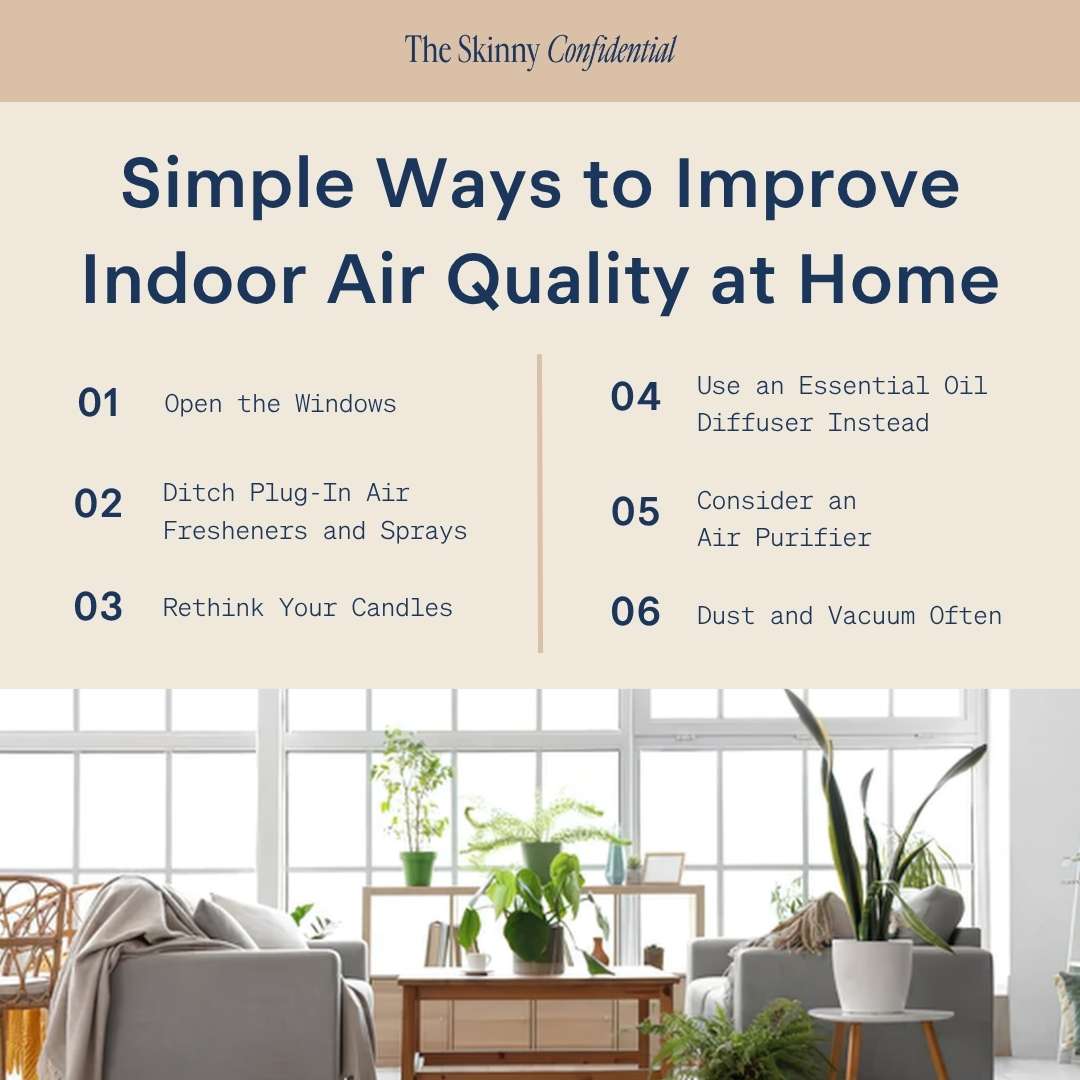
Improve Your Indoor Air Quality
Once you’ve narrowed down your cleaning products, it’s time to tackle your indoor air quality. It’s one of the top priorities when it comes to creating a healthier home.
Open the Windows
Can we start with the simplest (and totally free) way to improve your indoor air quality? Open up your windows and doors. Letting fresh air into your home can help clear out some of those pesky VOCs from cleaning products, furniture, and paint.
Ventilation helps dilute indoor pollutants, so open up regularly, especially while you’re cleaning or painting.
Pro tip: keep your windows closed if there’s wildfire smoke outside or it’s a particularly high pollen day.
Ditch Plug-In Air Fresheners and Sprays
Remember how air fresheners are a common source of VOCs? That’s exactly why we suggest ditching your plug-in air fresheners right away. Your home will still smell amazing. It’ll just smell clean.
Rethink Your Candles
We love a good candle as much as the next person. But depending on the wick and wax, some candles can release a lot of undesirable stuff into your home. If you’re looking to stock up on candles, we recommend learning more about which candles are non-toxic.
Use an Essential Oil Diffuser Instead
Looking for a way to freshen up your home? Try an essential oil diffuser. You skip the synthetic fragrance in plug-in air fresheners and still enjoy your favorite essential oils.
Just be sure to use your diffuser in a well-ventilated room. A little bit goes a long way.
Consider an Air Purifier
We suggest an air purifier with a true HEPA filter for the rooms you frequent most (aka your bedroom or living room). A true HEPA filter will help reduce dust, allergens, and other fine particles in the air.
Just be sure to find an air purifier that’s appropriate for the size of your room. If it’s too small, it won’t be able to adequately clean the air. Compare its CADR rating to your room’s square footage.
Dust and Vacuum Often
Believe it or not, there’s a good chance some unwanted chemicals are lurking in your dust. Dusting and vacuuming regularly will help you tackle them head-on.
Bonus points if you use a vacuum with a HEPA filter. It can help capture small particles rather than pushing them back into the air. Use a damp cloth for dusting, too, so you’re not just pushing dust around.
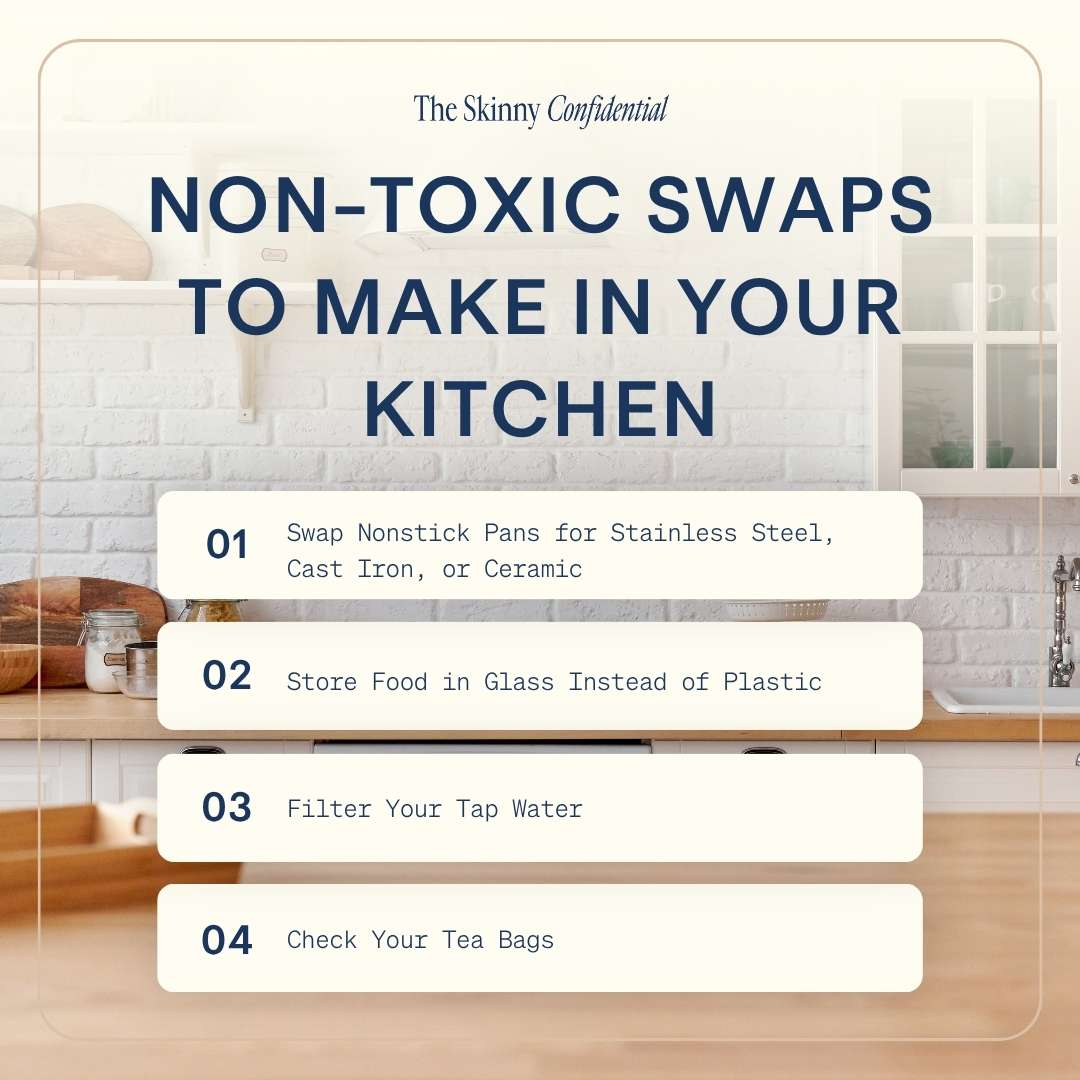
Clean Up Your Kitchen
Next up, it’s time to tackle your kitchen. After all, the materials we use to store and prepare our food matter.
Swap Nonstick Pans for Stainless Steel, Cast Iron, or Ceramic
Did you know that many traditional nonstick pans are made with PFAS? These are the “forever chemicals” that persist in the environment and can build up in the body over time.
PFAS-coated nonstick pans are considered safe for cooking when used as intended. But damage to the nonstick coating can release tiny particles into your food.
We suggest phasing out traditional nonstick pans as they become worn. Invest in stainless steel, ceramic, cast iron, or carbon steel cookware instead. You’ll cut back on PFAS exposure, and with proper care, stainless steel and cast iron cookware can last for decades.
Pro tip: not ready to ditch your nonstick pans just yet? Stop using any pan that shows scratches, flaking, or signs of wear.
Store Food in Glass Instead of Plastic
If you haven’t made the switch yet, start phasing out plastic food storage containers. Swap them for glass or stainless steel options, especially as they become stained or cracked.
Bonus tip: try to avoid microwaving food in plastic containers. Heating food in plastic can release tiny plastic particles from your container into your food. If you only have plastic containers, transfer your food to a glass dish or plate before microwaving.
Filter Your Tap Water
Depending on where you live, your tap water could contain chemicals you’d rather not consume. Check out your local water quality report (your local water utility releases one). It’ll help you figure out if filtering your tap water is a worthwhile investment for you.
If it is, choose a filter that’s specifically designed to address the contaminants in your water. That beats grabbing any filter off the shelf and crossing your fingers.
Check Your Tea Bags
Here’s one that might surprise you: some tea bags are sealed with plastic, which may shed tiny particles into your tea. If you’re a regular tea drinker, it could add up. Check out our post on plastic in tea bags for plastic-free alternatives to steep instead.
Upgrade Your Bedroom
You spend a big chunk of your life in your bedroom. That makes it a great place to start tackling toxins. Plus, cleaning up your bedroom can support better sleep (aka the best of both worlds).
Choose Organic Cotton Sheets and Bedding
Since you’ll be pressed up against your sheets for hours every night, we suggest investing in organic cotton bedding. When shopping for organic cotton bedding, look for two certifications.
GOTS (Global Organic Textile Standard) requires certified organic fibers. It also sets environmental and social standards at every step of production. OEKO-TEX Standard 100 means every part of the product has been tested for harmful substances.
The bottom line: GOTS can help you understand how your cotton was produced. OEKO-TEX can help you understand whether your finished product passed testing for harmful substances.
Look Into Your Mattress
This one’s not as easy as swapping out your sheets. When the time comes to replace your mattress, look into options without materials like polyurethane foam and flame retardants. Both can use off-gas chemicals.
When shopping for a new mattress, look for materials like natural latex and wool and certifications like GOTS and OEKO-TEX. Going with foam? Look for CertiPUR-US.
Air Out New Furniture and Mattresses
Ah, nothing quite like the smell of new furniture, right? Wrong. That “new” smell actually indicates that your furniture is off-gassing VOCs.
Furniture can be off-gas for a while. New furniture tends to release more VOCs since it hasn’t had time to off-gas just yet. Whenever possible, allow new furniture to off-gas in a well-ventilated space before you use it. Think: outside, in a garage, or in a room with open windows for a few days.
Keep Electronics Out of the Bedroom
This isn’t exactly a tip for reducing your chemical load, but we can’t stress it enough. Get rid of your tech (at least the screen kind) in your bedroom. Notifications and stimulation from electronics can keep your brain in “on” mode, making it harder to fall and stay asleep.
Save your sanity (and sleep) by charging your phone elsewhere. Need some tips on how to fall (and stay) asleep? Check out our guide on how to become a deep sleeper.
Rethink Your Laundry Routine
From your clothes to your sheets, laundry products end up making contact with your skin all day long.
Choose Fragrance-Free Laundry Detergents
Like many personal care and cleaning products, laundry detergents can contain potentially problematic ingredients. Ditch the highly scented detergents, which can leave synthetic fragrance in your clothes.
Fragrance-free (or mildly and naturally scented) options will get your clothes just as clean, without all of the extra ingredients. You (or the sensitive-skinned members of your household) may just notice the difference, too.
Swap Dryer Sheets for Wool Dryer Balls
Another simple switch. Wool dryer balls do the same job as dryer sheets (think: softer clothes, less static), and they can last for years. Looking to add some scent? Try adding a few drops of your favorite essential oil to one of the balls before you toss it in.
Skip Scented Boosters and Fabric Softeners
Scent boosters are mostly just added fragrance. Fabric softeners coat your fabrics with chemicals that can even make towels less absorbent over time. Try skipping these for a simpler (and cleaner) laundry routine.
Clean Out Your Bathroom and Beauty Products
When it comes to toxic products, the bathroom deserves a close look. That’s because your personal care products come in contact with your scalp and skin. Some even end up in your mouth (looking at you, toothpaste). Here are some ideas for simple swaps.
Swap Your Hand Soap and Body Wash
You use hand soap and body wash on a daily basis, so they’re great products to upgrade. Look for a fragrance-free (or naturally scented) product with a simple ingredient list, and skip those pesky synthetic additives. Try looking for products that can be refilled to limit waste, too.
Look at Your Personal Care Products
From shampoo to toothpaste to deodorant, you’re using these personal care products on a daily basis. Just like your cleaning products, look at the ingredient lists. Then try to switch out products as you run out of them. Check out our list of non-toxic oral care products for some inspiration.
Get Rid of Toxic Beauty Products
Time to bust out that makeup bag. Give the ingredient lists in your beauty products a once-over. Look for the ingredients you’re trying to avoid (hello, parabens and synthetic fragrance). Again, try to swap out products as you use them up so you’re not breaking the bank all at once.
The goal is products with fewer, cleaner ingredients. For example, our TSC Brow Peptide is made with just cold-pressed castor oil and peptides. Plus, it’s paraben- and fragrance-free. (Full disclosure: we make it and we sell it. But it’s a good example of what we’re talking about.)
Rethink Your Toilet Paper
Yep, even toilet paper. Some types are treated and processed in ways we’d prefer to avoid, considering how often we use it.
Wondering, is toilet paper toxic? Read more here to learn what to look for instead. Looking for more ideas? Check out our non-toxic product guide.
Make Smarter Choices About Furniture and Home Materials
We know, we’re not all going out and buying new couches this weekend. But these are some things to consider for the future when you do make purchases.
Buy Secondhand or Solid Wood When You Can
This can save you some money. Plus, solid wood and secondhand pieces that have had time to off-gas tend to have lower emissions. According to Sternfeld, buying vintage or antique can sometimes be a healthier option than buying new. Many older pieces were made from solid wood and natural fibers.
Look for Low-VOC Paint
This is an easy switch to make. Simply look for paint that’s labeled low-VOC or zero-VOC, since these off-gas much less than traditional paints. Open the windows while the paint is curing, too.
Prioritize the Pieces You Use Most
Again, we can’t all spring for new everything all at once. So start with the furniture you’re in the most contact with.
That would be items like your couch, bed, or your kids’ furniture. Decorative items like that chair you never sit in? Those can wait.
Choose Natural Fiber Rugs
Synthetic rugs are typically made of petroleum-based fibers and can off-gas. Instead, look for rugs made of natural fibers like organic cotton, jute, or wool. Sternfeld made this switch herself. She replaced her polyester-blend rug with a vintage Turkish rug made of wool and colored with vegetable dyes.
A Note on Health, and When To Ask a Professional
The information in this article is for informational purposes only and isn’t intended as medical advice. Talk with a qualified, board-certified medical professional about your specific situation if you have:
- Allergies or sensitivities
- A medical condition, particularly one that affects your respiratory health
- Other medical or health-related concerns
Have particular concerns about your home itself, like building materials or air quality? You may also consider hiring a certified building biologist to evaluate your space.
Start Your Non-Toxic Home With One Swap This Week
Want to make your home a healthier space? Start with one switch this week. Ditch your plug-in air fresheners, choose a fragrance-free laundry detergent, or crack open the windows for ten minutes each morning.
Pick one and cross it off the list. Progress trumps perfection every time.
It’s the same philosophy we live by here at The Skinny Confidential. Our founder, Lauryn Bosstick, built the brand around effective, no-frills products you’ll actually use.
From the TSC Ice Roller and TSC Mouth Tape to our TSC Brow Peptide, we believe small, thoughtful changes add up. Want to clean up your beauty routine, too? Explore the full lineup.
Expecting? Start with the space your little one will use most. Here’s how to create a non-toxic nursery.
XO, The Skinny Confidential team